The executive bureau - Operational Support for International Growth Companies Expanding into France

Summer in France: What International Companies Should Know About Operational Timing
Summer doesn't stop business in France. It changes the rhythm of execution.
7/12/20264 min read


Every country has its own business rhythms.
For international companies expanding into France, summer is often when this becomes most visible.
When most attention is focused on strategy, investment, hiring plans, and market opportunities, operational timing can become an afterthought, until the rhythm of the local market starts to shape what is realistically possible over the coming weeks.
Understanding how local business cycles influence execution can help companies currently navigating this period adjust their approach, maintain momentum, and prepare for what comes next.
Expansion Doesn't Happen Overnight
Establishing operations in a new country is rarely a single event.
Creating an entity, recruiting employees, selecting providers, opening bank accounts, securing office space, coordinating stakeholders, and launching local operations all take place over a period of weeks or months.
For a time, companies often find themselves operating in France while continuing to manage their expansion from another country.
Teams, providers, and stakeholders must be coordinated remotely while the local structure is still being built.
It is during this transition period that operational timing becomes particularly important.
Summer Creates a Different Operational Rhythm
Contrary to popular belief, business does not stop in France during July and August.
Companies continue operating, projects continue moving forward, and decisions continue to be made.
However, the pace often changes. Decision-makers may be on leave. Approval cycles can take longer. Meetings may require additional scheduling flexibility.
Projects that depend on multiple stakeholders can progress more slowly than anticipated. A delay of a few days at one stage can easily become several weeks when multiple dependencies are involved.
For companies working against ambitious expansion timelines, this can create unexpected bottlenecks.
Here is what this can look like in practice.
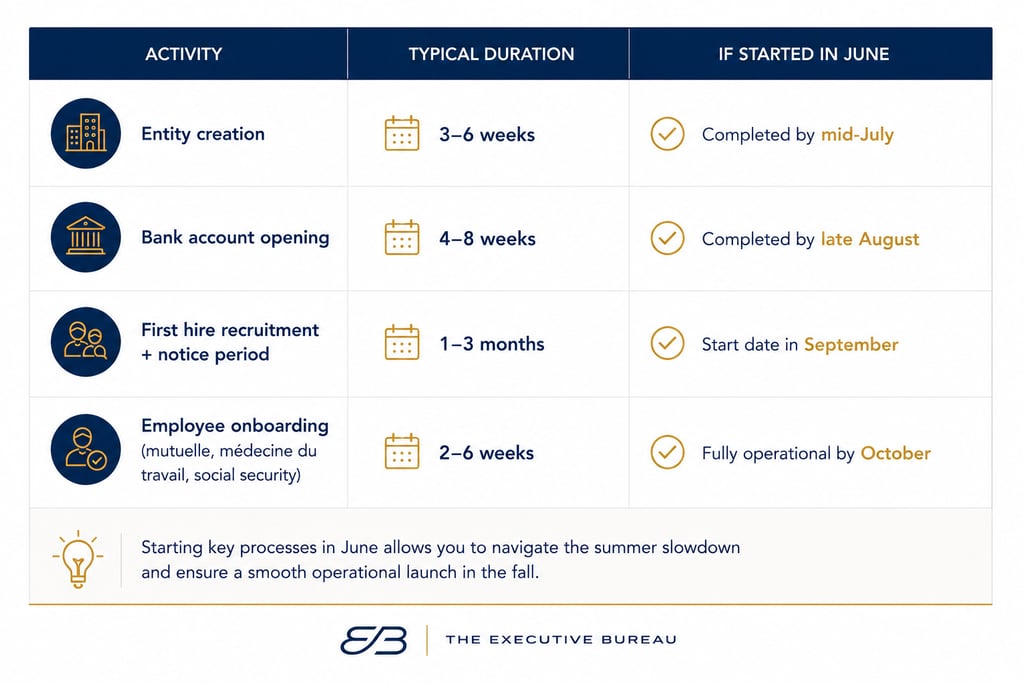
A company begins recruitment for a key local hire in early June. Notice periods for experienced hires in France typically range from one to three months. If the candidate's notice period runs through August, their start date may not fall until September, regardless of how quickly the recruitment process itself moved.
Once that person starts, onboarding requirements don't end with a signed contract. Mutuelle enrolment, médecine du travail (occupational health visit), and social security registration each involve their own processing steps — some of which depend on administrative bodies that also operate at a reduced pace over summer.
What looked like a June hiring decision can, in practice, translate into a fully operational employee closer to October.
None of these individual steps are unusual. The timeline simply reflects what happens when several sequential processes overlap with the summer period.
Timing Matters More Than Many Companies Expect
International expansion projects are often planned around business objectives:
market launch dates
hiring targets
customer commitments
funding milestones
growth objectives
Yet operational timelines are equally important.
For example:
Entity creation can take several weeks depending on the legal structure and documentation required.
Recruitment processes often include notice periods ranging from one to three months for experienced hires.
Office searches can take several weeks or months depending on requirements and location.
Provider selection, contract review, and onboarding may require coordination across multiple stakeholders.
Administrative procedures frequently involve several sequential steps, each dependent on the completion of the previous one.
Individually, none of these timelines are unusual.
The challenge is that many of them run in sequence rather than in parallel.
Small delays can therefore have a disproportionate impact on overall project timelines.
A June Decision Can Become an October Launch
Each step on its own seems manageable. Sequenced together, and overlapping with summer, the cumulative timeline shifts the project's effective start date by several months.
Build Timing Into Your Expansion Plan
The most successful expansion projects rarely focus only on the destination.
They focus on sequencing.
Questions worth considering include:
When should provider selection begin?
When should recruitment planning start?
Which activities can run in parallel?
Which milestones depend on others being completed first?
What happens if key stakeholders are unavailable for several weeks?
In practice, this often means starting certain workstreams earlier than the business timeline alone would suggest. A bank account process expected to take two months may need to begin before the entity is even fully operational on paper. A recruitment search for a role with a long notice period may need to start well ahead of the planned hiring date — particularly if the target start date falls after the summer period.
Addressing these questions early often helps maintain momentum later.
Expansion projects tend to move more smoothly when timing is treated as a strategic consideration rather than an administrative detail.
Successful expansion is not simply about completing individual milestones.
It is about maintaining progress across multiple workstreams over time.
Even when some stakeholders are unavailable, visibility, coordination, and follow-through remain essential.
Companies that plan for operational timing are often better positioned to keep projects moving and maintain execution momentum throughout the expansion process.
Operational Continuity Matters
Planning Ahead
International expansion is not only about strategy.
It is also about timing.
For companies currently navigating the summer period in France, understanding these rhythms can help anticipate what's ahead, and prepare for September, when pace typically picks back up and stakeholders return.
Because successful expansion is rarely determined by a single decision.
More often, it is shaped by the hundreds of operational decisions that follow.
At The Executive Bureau we support founders, executives, and international companies expanding into France through operational coordination, local execution support, and on-the-ground continuity.
If you’re currently navigating international expansion or building operations in France, feel free to reach out , we are always open to exchanging perspectives.
Insights
contact@executivebureau.co
© 2026. All rights reserved.
Want to know more?
Socials